Thursday, January 8, 2015

GEN. JOHN TWIGGS


GENERAL JOHN TWIGGS
 Revolutionary Hero

John Twiggs was born in the state of Maryland on June 5, 1750. Very little is known of his early life, other than he came to Burke County, Georgia with his family shortly thereafter. A child of a poor family, John took up the trade of being a carpenter. Twiggs caught the eye of Miss Ruth Emanuel, a firm lady of character and sister of the Hon. David Emanuel. Following their marriage John and Ruth moved to Richmond County, where they established a modest plantation.

As tensions began to mount between the American colonies and the King of England, more local difficulties began to arise. Twiggs joined the army as a lieutenant and as a captain, a position to which he was appointed on June 1, 1774, led a company of men of St. George's Parish in a successful operation against a band of Cherokee Indians who had been making raids along the settlements along the Georgia frontier. In 1779, Twiggs, in support of Col. William Few, defeated a contingent of British troops seeking to attack the jail in Burke County. In the months which followed the epic battle at nearby Kettle Creek, Twiggs kept British regulars at bay by skirmishing them at every opportunity and attacking their supply lines in the rear of their lines. John Twiggs found himself and thirty men under attack at Butler's plantation on the Ogeechee River in June, 1779. Outnumbered by more than two to one, Twiggs inspired his men to rout the British force causing a bit of consternation among the British officers in Savannah.
Not one to rest on his laurels, Twiggs encountered and conquered a band of British marauders at Buckhead Creek. On September 12, 1779, Twiggs and his company of soldiers joined General Benjamin Lincoln in preparation for an all out siege upon the British held Savannah. In one valiant and eventually futile attempt after another, the Continental army and local militia failed to liberate Georgia's ancient capital and most important city. In the retreat under cover of a flag signifying mutual respect for his status as an officer, Twiggs and his family were fired upon by British riflemen.

Following the fall of Charleston, the southeast's most important port, in May, 1780, Twigg's force joined General Horatio Gates' army in an attack at Camden, South Carolina. The colonial army, composed primarily of untested local militia, were trounced by Lord Cornwallis' battle-hardened veterans. Twiggs was nearly impaled by a saber, and left for dead on the battlefield. With the fire of freedom still in his soul, Twiggs returned to the Georgia backwoods to thwart his old enemies as they continued to pillage and terrorize the western regions of the colony.

Twiggs led American victories at Fish Dam ford and at Blackstock's house, where he personally led the attack against the fierce charge of the calvary of the villainous Banastre Tarleton. Though not given adequate credit for his actions by contemporary historians, it was indeed Col. Twiggs, who at the end of the day, was in command of the victorious colonists. During what was truly America's first civil war, a plot by an infamous Tory by the name of Gunn was uncovered and circumvented. When it was insisted that the poltroon be hung by the neck, Twiggs, in his usual forbearance, vetoed the execution of his assassin.

For his gallantry in action, the Georgia legislature, in its meeting in Augusta on August 18, 1781, named John Twiggs a brigadier general in the Georgia militia. Though the Revolutionary War was technically about to come to close in the early fall, British loyalists and discontented Indians were rumored to be mustering along the western frontiers in preparation for an attack on Augusta. For the remainder of the conflict, Twiggs organized for the impending attack, which never materialized.

After the close of the war, Twiggs retired to the solitude and enjoyment of his home, which he dubbed "Good Hope." He served a term as Justice of the Peace of Burke County in 1782. But the contentment was fleeting. On May 31, 1783, Twiggs along Georgia's most illustrious statesmen Lyman Hall, Elijah Clarke, William Few, Edward Telfair and Samuel Elbert met with a council of Cherokee chiefs in Augusta. The result of the negotiations was the purchase of a large tract of land in northeast Georgia. Nearly six months later, Twiggs helped to negotiate a treaty with the Creek Indians. Under the agreement the State of Georgia acquired all of the lands between the Ogechee and the Oconee rivers under a treaty, which precipitated a new war, a conflict which would evolve into a fifteen-year series of skirmishes and raids along both sides of the Oconee.

Treaty negotiations continued at Galphinton in 1785 and at Shoulderbone Creek. On September 8, 1791, Twiggs was again promoted by the Georgia legislature, this time to the position of Major General. It was during that year when Twiggs made his only engagement into politics by being elected to represent Richmond County in the Georgia legislature.

One of his most difficult assignments came in 1794, when Major General Twiggs was ordered to assemble a force of six hundred men to eject Twiggs' old comrade, General Elijah Clarke, who had, in the eyes of President George Washington and Georgia authorities, usurped his authority by establishing his own country along the western banks of the Oconee River in what would become Wilkinson, Baldwin and Laurens counties. Before the attack was launched, Clarke conceded and violence was averted.

In 1800, the State of Georgia honored General Twiggs by appointing him to the initial Board of Trustees of Franklin College, which evolved into the University of Georgia. Throughout his final years, this five-foot ten-inch stout man, with his florid complexion and gray eyes, remained active in civic affairs.

John Twiggs rarely sought any glory for his actions, only the satisfaction that he was serving his fellow man and protecting them from harm. In compliance with his wishes, no extravagant memorial would be placed on his grave. He died on March 29, 1816 at the relatively old age of sixty five. His body was laid to rest in the Twiggs family cemetery ten miles south of Augusta, off Georgia Hwy 56, on Goshen Industrial Blvd.

John and Ruth Twiggs had six children. One of them, David Emanuel Twiggs, served in the War of 1812, the various Indian conflicts of the era, and because of his heroic actions during the Mexican wars, was breveted a major general in command of the Department of Texas. When the Civil War erupted, Gen. David Twiggs surrendered his command to the Confederate army. For the act of treason and his acceptance of an appointment in the army of his homeland, Twiggs was dismissed from the Federal army. Another son, Levi Twiggs, was a field officer of the Marine Corps from the War of 1812 until his death during an assault on Mexico City in 1847. Two U.S. naval ships were named in his honor. A great grandson, Lt. Gen. John Twiggs Myers, earned high recognition in Marine Corps history for his valiant actions as commander of the American Legation guard in China during the Boxer Rebellion. His wife's brother, David Emanuel, served under Twiggs during the American Revolution and in 1801 was elected Governor of Georgia. On November 14, 1809, the State of Georgia immortalized the name of Twiggs by naming its newest county, Twiggs County, in his honor.

TY COBB, JR.


No Chip Off the Old Block

He was never a baseball player, although his name was Tyrus Raymond Cobb, Jr. He loved the sport of baseball, but he never played it on a professional level or even in high school. He loved other sports, especially tennis and hunting. His was one of the most famous families in Georgia history, though he never reveled in their fame. He would talk to others about his famous father. However, he had his own successful, but all too short career. He was a healer, and he took pride in doing his job and doing it well.

Tyrus Raymond Cobb, Jr. was born on January 30, 1910 in the home of his maternal grandfather, Roswell Lombard. Lombard, a well-known Augusta, Georgia businessman, lived on Dean’s Bridge Road, which later became known as U.S. Highway No. 1, just this side of Augusta. Ty Cobb, Sr. married Charlie Lombard on August 8, 1908. Ty, their second child was a bid red-headed baby, tipping the scales at nine pounds. Newspaper writers knew that he was going to be a great baseball player, just like his daddy.

The elder Cobb had made it to the pinnacle of the American League in 1909. He was the second of only fourteen players in major league history to win the Triple Crown, leading the American League in batting average, home runs (9), and runs batted in. Cobb also led the league in runs, hits, on-base average, slugging average, and stolen bases. The 1909 season, just before Ty’s birth, was one of the greatest seasons a major league ball player ever had. Cobb nearly won the Triple Crown three years in a row, leading the league in two of three categories. Cobb, considered one of the best and meanest players (his own teammates disliked his tactics) who ever lived, remains at the top of the all-time statistical leaders. Cobb is first in runs scored, and lifetime batting average with a .366 average. He got on base 43.3 % of the time. He was second in triples and hits, although he batted nearly three thousand less times than the leader, Pete Rose. He is fourth in games played, doubles, total bases, and at bats. Cobb stands fifth in runs batted in. In an era when stolen bases were not the norm, Ty Cobb still remains fourth on the all time list. Cobb, known as the "Georgia Peach," led the American League in batting average 12 out 13 seasons. Famous people came to visit Cobb, including President William Howard Taft soon before the younger Ty’s birth.


Ty Cobb, Sr.

The Cobbs moved into a two story home at 2425 William Street in the well-to-do Summerville section of Augusta, just a short distance from the current location of Augusta State University. Ty’s childhood was not like that of a typical Augusta boy. Visitors to the Cobb home included such legendary Americans as Knute Rockne, Bobby Jones, John Phillip Sousa, Robert Woodruff, and baseball commissioner, Kennesaw "Mountain" Landis. The sounds of classical music filled his home, while a wide variety of pets and animals were kept outside in the back yard. Although the elder Ty’s feats on the baseball diamond provided the Cobb family with all of the amenities of life, their family life was not so amenable. Ty Cobb’s legendary ball field temper came with him when he came home during the off season.


Ty Cobb Sr. (center) takes a portrait with his five children, (left to right) Herschel, Jimmy, Shirley, Beverly and Ty Jr. Ty Jr. spent years as a doctor in Dublin, Ga., before being diagnosed with brain cancer. He died living with his mother and sister in California. @ Augusta Chronicle, Don Rhodes, author of Safe At Home, a biography of Ty Cobb.


Ty, Jr. attended Richmond Academy in Augusta, where he was a two-sport star. Ty chose football and tennis, not even trying out for the baseball team. He knew that he could never match his father’s feats as a baseball player. Ty Jr., the antithesis of his father, was considered shy and took a lot of jealous ribbing from his fellow students. Ty loved to play tennis, then considered a game of the erudite. He played in the South Atlantic Tennis Tournament against Bill Tilden, the greatest tennis player of his day. Tilden, the first American to win at Wimbledon, became Ty’s personal tennis coach.

Ty attended Princeton University for a time before failing too many courses. He continued to play tennis after transferring to Yale University, where he was captain of the team. Ty returned nearer to home to study medicine at the Medical College of Charleston. He did his intern work at the University of Georgia Medical School in his hometown, without the financial aid of his father. While on a fishing trip in Florida, he met his wife, Mary Frances Dunn, whom he married on June 13, 1942. Ty returned to Augusta to his practice, before moving to Dublin several years later. The Cobbs had three children, Ty, III, Charlie, and Peggy. In 1945, Dr. and Mrs. Cobb bought the Hardeman Blackshear home at 1108 Stonewall Street, where the senior Cobb reportedly visited him on at least one occasion.

Dr. Cobb played very little organized baseball. He did love baseball. "He was my doctor, my favorite doctor," Wash Larsen recalled. "I still remember going into his office in the Thompson hospital on Rowe Street. It was a thrill just to go in and listening to his stories about baseball, and he had some good ones," Larsen said. Larsen and his friends practiced baseball on the ball field at the old fairgrounds at the corner of Telfair and Troup Streets. "Nearly every day, Dr. Cobb would pull up to the ballfield in his sports car. He would get out and ask if he could play ball with us. We said sure, of course, Dr. Cobb," Larsen said. After all, he was Ty Cobb, not the ball player, but as close as the young boys would ever get to him. "He hit all of our baseballs over the fence into the kudzu-lined ravine across the road and then left," Larsen fondly remembered. Larsen and his friends went to the kudzu patch and found every ball they could, hoping that Dr. Cobb would come back the next day and hit them over the fence again, which he did. Dr. Cobb was one of the better golfers in Dublin. He loved hunting. One day he was out on the Oconee River hunting for game birds. When he hit his first wild goose, he found a band on the bird's leg. Cobb stated, "I nearly fell out of the boat." The bird came from a wildlife refuge and the home of his friend, the famous Jack Miner. The Ontario refuge, where Cobb had visited many times as a child and an adult, was home to thousands of birds under the protection of the Canadian government.

As a doctor, Ty Cobb became one of Dublin’s finest and most respected physicians. Cobb joined Doctors A.T. Coleman and Fred Coleman and the American Legion in calling for the construction of a county hospital in Dublin. Early in 1952, Dr. Cobb was diagnosed with a brain tumor. He underwent an operation and lived for a time with his sister Shirley Beckworth in New York. The family kept him in New York, knowing that the hot Dublin summers wouldn’t be good for him. Although he looked healthy, the cancer was destroying his brain. In a poignant meeting, Ty, Sr. offered to give Ty, Jr. a bird dog. Ty had enough memory left to realize that his father had never given him anything.

Tyrus Raymond Cobb, Jr. died on September 9, 1952. He was entombed in the family mausoleum in Palo Alto, California. His father died in 1961 and his mother in 1975. She was entombed by her sons, while Ty, Sr. chose to be laid to rest in his hometown of Royston. Dr. Cobb’s fellow Dublin Rotary Club members started a memorial scholarship fund in his memory dedicated to providing scholarships to medical students. Dr. Cobb’s son, Charlie probably summed up the essence of his father when he said, " I don’t care what time he came in from treating his patients or delivering babies – sometimes two or three in the morning – my father always would come into our bedrooms and give us a kiss. I probably remember that more about him than anything else."

MATTIE HESTER


MATTIE GET YOUR GUN
The Story of Mattie Hester

Mattie Hester was a combination of Annie Oakley, Calamity Jane and a pony express rider. A headstrong woman in a male dominated world, Hester could hold her own with the strongest of brutes. This is a tale of one remarkable woman and her brief moments of fame. Martha "Mattie" Hester was born about the year 1868. Her parents, John and Mary Hester, lived in the southeastern part of Laurens County on the east side of the river in what is still known as Smith's District.

Mattie grew up in an era when mail delivery was intermittent and slow. Condor was established as a post office in 1878. Two years later, an office was established further south along the River Road at Tweed. Most of the mail coming into Laurens County first came into Dublin for distribution to other places throughout the county. It was about 1890 when Mattie was given the job of carrying the mail from Dublin to Condor where she began her route. From Condor, she traveled south three days a week along the Old River Road to Lothair in what was then Montgomery, but which now lies in Treutlen County.

Female mail carriers were rare. The forty-five-mile route was often isolated. Any miscreant looking to steal cash or a valuable document could easily rob a carrier along the road. But Mattie would not be deterred. She hitched a Texas broncho to her small road cart to allow her to outrun any thieves. Her horse, faster than a hemidemisemiquaver in a John Phillip Sousa march, never failed Mattie.

She always got the mail to its destination on time or well ahead of its scheduled arrival. If she was accosted, Mattie was as fearless as anyone. To insure her safety, she carried a .38 caliber Smith & Wesson revolver in her side pocket. Mattie was considered a crack shot, and no one who knew her would ever contemplate trying to take any mail or in anyway impede her delivery schedule. Lacking no doubt about her ability to defend herself against any highwayman or tramp in her path, Mattie Hester held little respect for members of her own sex who feared to venture out into public without an escort.

A prime example of Mattie's determination occurred during a winter rainy spell. After nearly a week of constant rainfall in the summer of 1890, the creeks and streams along the mail route had swollen beyond their banks. Messer's (Mercer's) Creek, which serves as the boundary line between Laurens and Montgomery (now Treutlen) counties had become a raging torrent. The long bridge, usually dependable for most crossings, was in danger of being swept away at any moment. Its abutments were already gone. Upon her arrival at the bridge, Mattie surveyed the perilous situation. Recognizing the danger ahead, but acknowledging the necessity of the mail being delivered, Mattie decided to plunge ahead. "If there is any possible chance to cross, I intended to cross, even if I have to swim," said Mattie. Mattie whipped the hind of her trusty bronco and plunged into the turbulence. Her horse found itself tangled in a patch of vines in five feet of water. Instinctively Mattie cut the helpless horse from its harness. Battling shoulder deep raging currents Mattie persevered, all the time dragging the cart until she could reach the bridge which by then was cover with water itself, but still standing. She managed to make it across and did her pony. After a moment or two of rest, Mattie hitched the drenched horse to the wagon and resumed her journey, albeit she excusably took nearly an hour to travel the remaining seven miles to Lothair.

Mattie's duties at home and the pittance of a salary she received from the Postal Service led to her resignation as a postal carrier. One might think that this fiercely independent, pistol packing and hard charging woman might have a manly image. To the contrary, Mattie was described a reporter for the Atlanta Constitution as "a beauty of a real southern type, wavy black hair, deep blue eyes, beautiful figure and complexion with the whitest teeth imaginable." "Her jaunty air and pretty face never failed to attract the attention of strangers, as she rattled swiftly by in her cart, never looking to the right or to the left, but attending strictly to business," the reporter continued. I

n addition to her admirable qualities of dedication to her work and striking beauty, Mattie was considered to be an astute businesswoman. Following her father's death at a relatively young age in 1890, Mattie took over the management of the family farm. Mattie took part in all phases of the farming operation, from cultivation to planting and from harvesting to marketing to the highest bidder, the latter of which were among her greatest talents. Always looking for a way to improve the income from her home place, Mattie ventured into the woods behind her house and saw money in the trees. She cut some of the trees and personally assembled them into a raft. In the process she had to wade throughout the swamp, sometimes with water up to her waist. Mattie's brother took over at that point and piloted the timber raft down the treacherous waters of the Oconee and Altamaha rivers to the port city of Darien, where the logs were sold at a handsome profit. The venture became so lucrative that Mattie saved a few of the trees and invested some of the income into constructing a split rail fence around the Hester farm. By the best count available, Mattie cut about five thousand rails during her first five years of managing the farm. Mattie spent her spare time teaching young people how to shoot. She also a talent for penmanship and drawing.

Mattie's marksmanship came in handy when someone needed defending. On an early December evening in 18906, a Mr. Palmer was giving a dance party in his home in the Martha community near Tweed. Mattie's entrepreneurial abilities included the sale of spiritous liquors. It was said she sold her stock freely among the male party goers, many of whom found themselves under the influence of Mattie's liquor. As more and more whiskey was consumed, tempers began to flare. Mattie found herself engaged in a heated argument with Henry McLendon. Maggie drew her pistol and shot her antagonist. Mattie's brother rose to her defense, but was brutally beaten about the face with a pair of brass knuckles. Alfred Shell, a steam mill owner, was also shot and seriously wounded.

Mattie seemed to disappear after that. Was she forced to leave the community? If so, where did she go? Did this beautiful and fiercely independent woman ever marry? Maybe one day we will know. 

KILLER KILDEE


KILLER KILDEE
Or Just Another Tall Tale Teller

John West could tell a tale or two. He claimed he was the Confederacy's best rifleman having killed generals and scores of officers and privates as well. Is the story of John West, alias "Kildee," an accurate story of a sharpshooting soldier or just an inflated fable of early yellow journalism to sell books, or merely the boastful reminiscences of an aging veteran of a horrible war?

West was born in Twiggs County, Georgia. When the Civil War broke out, West enlisted in the Confederate Army in Louisiana, but decided that it was best for him to transfer back his native land to fight the Yankees. On July 9, 1861, John West enlisted as a private in the Twiggs Volunteers, officially known as Company C of the 4th Georgia Volunteer Infantry. Also known as "the "Jorees" because of the resemblance of their uniform coats with their three black stripes on the tails to a beautiful bird of the era, the Twiggs Volunteers were assigned to the brigade commanded by A.R. Wright of Georgia. Their first taste of battle and blood began in the last week of June 1862. In a series of engagements along the peninsula of Virginia east of Richmond, the Army of Northern Virginia and the Army of the Potomac slugged it out in a prelude of the deadly battles to come. The battles, known as the Seven Days' Battles, culminated on July 1, 1862 at a small prominence known as Malvern Hill. In the fighting, West suffered his first substantial wound.

Many of the rifles which were used by Confederate soldiers had a limited range. It was in 1862 when General Robert E. Lee received a shipment of thirteen English Whitworth rifles, guaranteed to kill a man at a range of 1,800 yards and arguably the finest rifle that a soldier could possess. West was selected among an elite group of marksmen to train for three months on how to handle the coveted weapon. As the training came to end, West was ahead of the other dozen sharpshooters. In the final test a white board with a two-foot square diamond in the center was placed 1500 yards away. Shooting through a stiff wind, West scored three bulls' eyes, with the remaining shots striking the board. As the winner of the contest, West was given the choice of a horse, a rifle, a saber, a revolver and all of the finest accouterments.

Sharpshooters were an integral part of military operations. The men were often placed at strategic points to kill officers, silencing batteries, and especially picking off the sharpshooters on the other side. Artillerymen were easy targets, but when riled, would turn their canon on a sharpshooter and blow him a way. On one occasion, West and a associate killed the entire compliment of soldiers in a battery, allowing the infantry to take command of that part of the field.

West told the editors of Camp Fire Sketches and Battlefield Echoes, "I soon became indifferent to anger and inured to hardships and privations. I have killed men from ten paces to a mile. I have no idea of how many I killed, but I made a good many bite the dust." The sharpshooter's greatest fear was another sharpshooter. In the days before the advent of camouflage material, a sharpshooter would climb a tree and pin leaves to disguise his uniform. When two sharpshooters encountered an enemy sharpshooter, one would raise a hat on a stick or his ramrod to draw his antagonist's fire. Once the opponent revealed his position, the second marksman would point his sight directly at his head and fire.

"I've shot 'em out of trees and seem 'em fall like coons," West boasted. Occasionally West would be called upon to pick off targets while lying in a bed of tall grasses. Sparks from the discharge of his rifle frequently ignited the dry grasses and alerted the enemy of his whereabouts. West would then roll his body rapidly while Union riflemen poured round after round into the smoke. West claimed that he killed two Union Generals, General James Shields and Nathaniel P. Banks. The crack shot was sure he got General Shields as he was the only sharpshooter on the line that day and only a round from his rifle could have killed a man at that range. Shields was in command of a Union division near Winchester, Virginia in the late summer of 1864. He was wounded, but he was not killed. He went on to represent Missouri in the U.S. Senate and died fifteen years after his wound at Winchester. No record exists of any wounds suffered by General Nathaniel P. Banks, though his division was thwarted by Stonewall Jackson's Army at the Battle of Cedar Mountain in August 1862. Banks served ten terms in the U.S. Congress and lived for nearly three decades after the close of the war.

At Cold Harbor, Virginia, West found himself and a Colonel Brown on the wrong side of the Union lines. West and Brown, wearing blue coats, attempted to fool a Union officer into believing that they were officers and needed to pass in front of the Federal wagon train. When the ruse was revealed, Col. Brown fired his revolver striking the Yankee officer. A hail of bullets was heaped upon Brown and West, who were attempting to flee for their lives. Brown's horse went down and both men tumbled to the ground. Thought to be spies, Brown and West were put under a close guard during the night by four Union soldiers. Deciding that trying to dodge four bullets in the dark was preferable to twenty bullets of a firing squad at dawn, the captives crawled on their bellies evading the inattentive sentinels and made their way to freedom.

During the fighting at the second battle of Cold Harbor, West was positioned at the front of the Confederate lines. For hours, West futilely tried to pick off a Union sharpshooter who had been killing his comrades all day. " I was behind a large rock. Several times he shot at me. He was out there about 1,400 yards in the woods, but I couldn't see his smoke for the treetops," West lamented. After two hours of silence, General George Doles, of Milledgeville, Georgia, appeared on the scene and asked West to silence that devilish tormentor of his men. "He asked me to do my best, and I told him that had been trying to do that all day," John remembered. It was then that Doles stepped in front of West and exposed himself. West warned the general to look out and take cover. At that instant a mini ball struck the general in the right side and passed through his body killing him instantly. West carried General Doles from the field and escorted his body home for burial in Milledgeville.

Though he may have never killed a general, John West believed it was his gun which fired the fatal shot which killed Major General John Sedgwick at the Battle of Spotsylvania on May 9, 1864. While some doubted the story, West lent his gun to Charley Grace while he was in the hospital and it was true that Grace fired the fatal shot.

John West surrendered with his company at Appomattox C.H. on April 9, 1865. He tried to conceal his prized rifle in a blanket, but it was discovered and confiscated. He spent the rest of his life trying to get his gun back. After the war, West returned to Twiggs County to farm. West enjoyed attending Confederate reunions and telling stories of his days as one of the best sharpshooters in the army. He died in 1912 and is buried in the family cemetery on Fountain Road, 2.3 miles west of the intersection of Highway 18 and Fountain Road.

BILL ROBINSON


A Baseball Survivor

Bill Robinson died on the last Sunday in July.  Unless you are an "old school" baseball fan, you probably wouldn't even know his name.  Robinson, the biggest star of the 1962 Dublin Braves team, was revered by those who knew him as a decent man, one who was a well-respected hitting instructor and coach.  His pupils won two world championships.  A sixteen-year veteran of the big leagues, Robinson won a World Series ring of his own with the Pittsburgh Pirates in 1979.  This is the story of a man who was once billed as "the black Mickey Mantle" and survived the intense pressures of major league baseball for a successful 47-year career in "America's pastime." 

William Henry "Bill" Robinson was born on June 26, 1943 in McKeesport, Pennsylvania.    After high school, Bill was signed by the Milwaukee Braves and assigned to their farm team in Wellsville. At the age of 18, Bill Robinson was ranked by scouts as one of the best rookie outfielders ever, better than Mickey Mantle and Reggie Jackson.   At first, his future in baseball seemed dim.  After a poor season in Eau Claire, Robinson was assigned to the Dublin Braves in the Georgia Florida League.  In his first game with Dublin, Robinson impressed the fans with a single and a double to drive in four runs.   Under the tutelage of the wily veteran manager Bill Steinecke, Robinson reversed his downward spiral  and posted a highly respectable .304 average with 21 extra-base hits in 207 at bats. 

Following a system wide reorganization of the minor league farm systems, Robinson was assigned to the Waycross Braves in 1963.   Bill's star continued to rise with a .316 average at Waycross and a .348 average with Yakima in 1964.    Facing stiffer competition, Robinson's stats tailed off with the Atlanta Crackers the following year.  An International League all-star with the Richmond Braves in '66, Robinson excited the big league team in Atlanta and scouts around the country with an outstanding .312 average, 20 home runs and 79 runs batted in.  After five years of bus riding and hectic living, Robinson finally made it to the majors during a late season call up in the Braves' first season in Atlanta on September 20, 1966. In 11 at bats, he garnered three hits.

With Roger Maris being traded to the Cardinals and the future of an aging and aching Mickey Mantle in doubt, New York Yankee manager Ralph Houk salivated at the thought of Robinson in his outfield.   "He has the best arm I have ever seen," Houk told a reporter for the Washington Post.     On November 29, 1966, the Yankees traded the veteran third sacker Clete Boyer to the Braves for the young Robinson, who carried with him a .298 average, a rocket arm and the possessed the power to become what the Yankees hoped would be "the black Mickey Mantle."

An early indicator of Robinson's throwing ability was his skill in throwing rocks at his antagonists.  Somewhat of a runt in comparison to the bullies of Elizabeth, Pennsylvania, Robinson compensated for his scrawniness.  "When I was about 10 years old, there was one boy who used to beat me up all the time.  One day I waited at the top of a hill and split his head open with a rock from 20 yards.  I guess I could hit a guy with a rock at a hundred yards.  I was pretty accurate," Robinson chuckled.  

After developing a soreness in his right throwing arm in the Venezuelan winter ball league, Robinson underwent elbow surgery in the winter of 1967.  Robinson struggled in his rookie season.  With manager Houk's unfaltering patience and encouragement, Bill Robinson once again reversed his slump and surged to bat .260 in the second half of the 1967 campaign.  

Robinson's sophomore season with the Yankees mirrored his rookie season.  Mired in a horrific slump at the all-star break, Bill silenced his doubters with a .282 second half, and solidified a starting position for the 1969 season.     Robinson returned his blessings to the community by actively participating in youth programs in New York.   After a dismal season in '69, Robinson feared his baseball career was over.  At the age of twenty-six, Bill appeared to be headed for the verge of  obscurity.  Yankee fans,  instinctively and unmercifully, booed Bill.   The pressure to replace "the Mick" was unbearable.   After three average seasons in the minors with Syracuse, Tuscon and Eugene, Robinson finally returned to the major leagues toward the end of the 1972 season with the Philadelphia Phillies, who hoped to capitalize on his resurgent power hitting.

Robinson, who could play all three outfield positions, led the Pacific Coast League in   rbi at the time of his call up to the Phillies.  With the pressure of being expected to perform with the legendary Yankees gone, Robinson returned to his youthful form.    He hated to go to the ball park (in New York) where he tried too hard to perform up to the impossible standards set for him by management and fans alike. Frustration led to more frustration.  The White Sox had assigned Bill to their Tuscon team in 1971.  Robinson felt he was lied to by the Chicago team and actually quit baseball, only to be traded to the Phillies, a move which rejuvenated his career.

Robinson shed his demons and began to enjoy baseball again. Wally Moses, a native of Montgomery County, Georgia and the Phil's hitting instructor, resurrected Robinson's natural hitting style.  Bill entered the 1973 season,  hoping just to  remain on the team for 52  days to qualify for a pension.  Little did "Robby" know he would still be around a decade later.  1973 was Bill's best season so far.  He batted .288 and hit 25 home runs. Seventh in at bats per home run, ninth in slugging percentage and tenth in extra base hits in the National League, Robinson appeared headed for stardom at the age of thirty.    But Robinson's roller coaster career took another dip in 1974 and he was traded to the cross state rival Pittsburgh Pirates in the off season.

A valuable substitute outfielder, Robinson played well for the Pirates and played for the Bucs in the 1975 post season playoffs against the Cincinnati Reds.  Though Bill accepted his job as utility outfielder, he wanted to play full time. When Pirate outfielder Dave Parker went down in May 1975, Robinson got his shot at starting in Pirate outfield.   Robby  was asked to play third base when Richie Hebner went on the disabled list.  Bill enjoyed playing on the hot corner as it kept him more involved in the game.  Bill Robinson responded to the challenge both eagerly and favorably, since the Pirates had a trio of outfield stars.  Though he ended the 1976 season with a .303 batting average, Robinson went into August batting at an amazing clip of.340.  With 64 rbi and 21 home runs, Bill Robinson was chosen as the team's most valuable player and finished 21st in the balloting for the National League's Most Valuable Player.    Robinson had reached the prime of his career.  Suddenly, at the age of 33, he was on the verge of becoming a superstar.

Bill Robinson entered the 1977 season, his 10th full year in the majors, with high expectations.  A series of ham string injuries, a bad shoulder and an aching leg couldn't hinder his determination to show his 1976 season was no fluke.  Though he wasn't considered for the 1976 all star team with a .335 average, Robinson thought he might have a chance in 1977.  Robinson was devastated when his name didn't appear on the 1977 ballot.  Thoroughly disgusted at what he termed as a farce of a voting system, Robinson vowed not to play, even if was selected as a substitute.

Robinson continued to excel.  He got his first ever on screen interview with the venerable Howard Cosell on Monday Night Baseball.   Bill told the bumptious Cosell that he had alleviated the pressure and went up to the plate without any worries.    When called upon after first baseman Willie Stargell was scratched from the lineup due to an injury, Robinson moved across the diamond for the good of the team.  

1977 was Robinson's career year.  Eleventh in the balloting for the NL Most Valuable Player, Robinson finished eighth in the league in slugging percentage and runs batted in,  and sixth in doubles posted career highs in home runs (26), runs batted in (104) and batting average (.304.)    

Bill Robinson returned to the outfield in 1978, replacing Al Oliver, who had been traded to Texas.   With a contract extension in hand removing him from the bottom of the pay list for regular players, Robinson looked to improve on his totals of the '77 season.  After getting off to a hot start, a nagging thumb injury altered his outstanding swing.  After six seasons of virtual serenity, the pressure began to nag at Bill once again.    His hitting had gone from consistently torrid to woefully inconsistent.

The Pirates began acquiring new players to step in, just in case Robinson faltered in 1979.   His average dropped to .246, the third worst of his career.  Just when it looked like he would once again fail, Robinson turned it up and moved to the top of the team's offensive statistical categories. Robinson's return to brilliance helped the Pirates to win the National League's Eastern Division pennant.

The Pirates adopted the song We Are Family as their theme song for 1979.  The Pirates easily swept the powerful Reds to face the Baltimore Orioles in the World Series.  In a rematch of the '71 series, the Pirates won in the seventh  and deciding game.   Hitless in three at bats  in the league championship series, Robinson got five hits in the series to win his first World Series championship ring.

Still considered a good utility player, the Pirates held onto the aging Robinson after his home run total fell to 12 in the 1980 season, though he did hit .287.    Nagging injuries to Willie  Stargell and Dave Parker kept Robinson in the lineup despite the fact that he was 37 and was beginning to slow down.  Robinson didn't disappoint Pirate manger Chuck Tanner and played another solid season for the Pirates.

The end of Robinson's career began in the spring of 1981 when he underwent surgery for the repair of his right Achilles tendon.  Bill never regained his quick bat and posted the lowest average of his National League career.  After 31 games with the Pirates, Robinson returned to Philadelphia for the remainder of the 1982 season.  At the end of the season, Robinson, approaching his 40th birthday, filed for free agency.  He was resigned by the Phillies and played only in ten games before being released on June 9, 1983,   seventeen days after his final game on May 23, 1983.   The Phillies respected Robinson's knowledge of him and retained him as a minor league hitting instructor. 
In his sixteen seasons in the major leagues, Robinson had 1127 hits,  166 home runs and drove in 641 runs.  He hit 104 round trippers in the minors along with 514 runs batted in.  His career batting average of .258 in 1472 games was not a true reflection of his outstanding career in the 1970s when he was a better than average hitter.

At the end of the '83 season, Robinson was wooed by the Mets as their new batting coach.  With the likes of Darryl Strawberry, Keith Hernandez and George Foster in the Met's lineup, Robinson wasn't about to begin making changes in his slugger's swings.  "I don't have any complicated ideas about hitting,"Robinson said.  "Mine is a very simple approach, mostly mental," said Robinson, who was manager Dave Johnson's first choice because of his ability as a teacher of hitting.

Facing the brink of elimination in the 6th game of the 1986 World Series, the Mets rallied and took advantage of one of the greatest blunders in World Series history to send the series into the seventh and deciding game, which the Mets won.  Robinson had once again returned to the top of his form, this time as the man who taught the world champions the art of hitting.  Robinson remained with the Mets until the end of the 1989 season when the team made wholesale changes in their coaching staff.
In 1990,  the producers of Baseball Tonight hired Robinson for his insightful commentary on major league baseball.  After a two-year stint with ESPN, Robinson returned full time to baseball.   Robinson worked for the Phillies minor league organization as a manager and coach from 1994 though 1999.  Bill returned to the Yankees organization  as a minor league hitting instructor for its Columbus team from 1999 to 2001.  He accepted the offer of the Florida Marlins to serve as their hitting coach for the 2002 season. 

Once again in 2003, Robinson's pupils, the surprising Florida Marlins, shocked the baseball world by capturing the World Series title, earning Robinson his third and final World Series ring. After four seasons with the Marlins, Robinson was hired as the hitting instructor for the Dodger's minor league system.    

On July 29, 2007, Robinson failed to show up for an appointment in Las Vegas to discuss hitting.  He had complained about his heart after throwing batting practice and went back to his hotel room to rest.  A friend found him dead. Apparently his heart simply gave out.  His Bible was lying open in front of him.

Jeff Wilpon, the CEO of the Mets described Robinson as "a devoted family man, a consummate professional and one of the classiest men in our sport."  "Bill was a wonderful family man and a great player, manager and coach.  He was a friend to everyone he met,"  said Dodger general manager Ned Colletti.  

HUBERT MIZELL


HUBERT MIZELL
A Legend That Never Ends


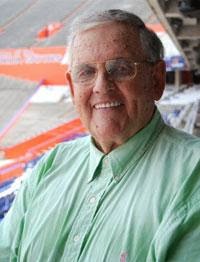
In a world where cliches are never cliche, Hubert Mizell has seen it all.  For the last fifty years, he has written about courage, loyalty and self-sacrifice.  Hubert has told stories of leadership, teamwork and the triumph of the human spirit.  He loves sports and loves to write about the events which keep on taking us out to the old ball game.  For this Dublin native, his dream to become a sportswriter has come true, more than he could ever imagine.


Hubert Coleman Mizell was born in Dublin, Georgia in 1939.  His parents, Leon Mozart Mizell and Annie Mae Williams Mizell, named him for Dr. Alfred Coleman, the doctor who delivered him.  Hubert grew up in the days of Joe DiMaggio, Ted Williams, Stan Musial, Ben Hogan, Sam Snead and Joe Louis.  As a child of a poor family, Hubert lived in eleven towns and in twenty-seven buildings.  His father left school after the end of the 5th grade.  A saw mill accident left the elder Mizell with a severely mangled arm, relegating him work at strenuous jobs, often enduring eighty-four-hour work weeks.  Hubert's mother worked whenever and wherever she could to help make ends meet to support the family, which included Hubert's baby sister Linda.


When Hubert was seven, the Mizells moved to Jacksonville, Florida.  A trip to the Georgia-Florida game, long before it became the wild spectacle  it is today, sparked young country boy's love of sports.  At the age of fourteen, Hubert took a job as an usher and later as a scorekeeper at Wolfson Park, home of the Jacksonville Tars.  Playing for the Tars that year was a young kid by the name of Henry Louis.  You know him better has Henry "Hank" Aaron.


Before he completed high school, Mizell developed a relationship with the Times-Union, Jacksonville's leading newspaper.    At first he worked as a sport's copy editor.  During his spare time, Hubert studied and carefully analyzed the writings of the nation's greatest sportswriters.  After his college days at the University of Florida were over, Hubert returned to the Times-Union as the High School Sports Editor.  In 1964, he took a job in the public relations department of the Gator Bowl.


In 1967, Hubert came of retirement as a sportswriter for the first time.  He returned to the Times-Union as its Florida Sports Editor.  In addition to his duties in the sports department, Mizell covered hurricanes and even the 1972 Republican National Convention.  Later in the 1970s, Hubert became the state sports editor of the Times-Union.


Hubert Mizell's first major sports assignment came in the late summer of 1972.  Hubert witnessed swimmer Mark Spitz's world record seven gold medal performance and the emergence of one of the world's greatest gymnasts, Olga Korbut.  He was there when the zebras gave the Russian team three unwarranted chances to defeat the US basketball team in one of the most controversial games in Olympic history.  Hubert was an eye witness to one of the darkest moments, not only in Olympic history, but in the history of sports.   Working closely with a young Peter Jenkins of ABC News, Hubert saw the hooded gunmen who killed eleven Israeli athletes.   He was stationed at the airport when their corpses were sent back home.  "It was like a punch in the stomach," Mizell remembered. Hubert still lists the '72 Olympics as the highlight of his career.


Being based in the subtropical climate of Florida, Hubert normally didn't cover hockey games.  But in the winter of 1980, Hubert was in Lake Placid, New York, covering the first of his four Winter Olympic games.  Mizell and the corps of sportswriters, normally trained to be neutral in their coverage of sports, shivered in emotion as they witnessed, in Mizell's words, "the most colossal upset in the history of sports."  Mizell still rates the game in which the upstart US team defeated the heavily favored Russians  as the No. 1 game he has ever covered.  In 1986, he moved to Atlanta and took a job as a feature writer and television critic for the Atlanta Constitution.  It wasn't long before Hubert decided to return to Florida and the love of his life.


Mizell was present at one of baseball's most memorable games, not because of the score or the events which transpired on the field.  It was late in the afternoon on October 17, 1989.  The Giants and Athletics were preparing to play their 3rd World Series game when the stadium began to shake violently.   Hubert hit the floor and then the lights went out.  He managed to make it out of the stadium safely, writing his column on the hood of an ABC -TV truck.  The calamitous earthquake was the most frightening thing Hubert ever witnessed in sports.


During his fifty years in journalism and sports, Hubert has attended nearly fifty college football bowl games, forty Masters golf tournaments and  more than thirty college basketball final fours and Super Bowls.  He has been in attendance at more than a dozen U.S. Golf Opens and Kentucky Derbies.  Hubert has crossed the Atlantic to witness a half dozen or more British Open golf tournaments and even more Wimbledon tennis tournaments.  Mizell has covered six summer Olympic games and four of the winter games.  The number of the other sports events he has seen is virtually incalculable.


College football and golf are Hubert's favorite sports.  He loves going to Notre Dame to watch a football game the best, though he does rank Grant Field as number nine and between the hedges at Sanford Stadium as his sixth most favorite college football venue.  He lists Arnold Palmer, Steve Young, Pete Maravich, Jack Nicklaus, Magic Johnson and Richard Petty as his favorite athletes.  Interestingly, he list former Tampa Bay Buccaneer Lee Roy Selmon as the most honorable athlete he has known.  Nancy Lopez is a close second in his mind.  Among the most mesmerizing interviewees, Mizell lists Muhammad Ali, Bobby Jones, Jackie Robinson, Joe DiMaggio, Red Grange, Charles Atlas and Jesse Owens.  His favorite sportscasters include Pat Summerall, Jim McKay, Bob Costas, Jack Whitaker and Howard Cossell.


Frequently honored by his colleagues, Hubert  has served on the ESPY committee of ESPN Sports, which annually honors the best of the best in sports. Mizell was a charter inductee into the United States Basketball Writers Hall of Fame.  In 1980, his fellow sportswriters elected him as president of the Associated Press Sports Writers Association.  Chris Berman of ESPN remembered Hubert for being kind in helping him out when he first got into broadcasting.  Veteran St.  Louis announcer Jack Buck said, "Everybody loves Hubert, especially the athletes - they trusted him."  Jack Nicklaus said "Hubert tried to do the right thing and be in the right place at the right time."  Fellow golfer Gary Player echoed Nicklaus, "He's been a tremendous contributor to golf, but he's been a great gentleman.  Really a nice man and you can't say much more about a person than that."


Hubert retired from sports writing, at least partially, in 2001. He and his wife moved to Virginia and the promise of peace and quiet. Hubert did continue to write a weekly column for the St. Petersburg Times until the end of 2004.  He planned to retire, but Hubert couldn't leave sports.  He returned to the sports room last year and writes today for the Gainesville Sun.    This past April Hubert Mizell was honored by the Augusta National Golf Club, which awarded him and thirteen other writers and broadcasters with the first "Masters Major Achievement Award." According to the editors of Sports Cliches dot com., a sportswriter must be around for at least thirty years to qualify as a legend.  Hubert Mizell is twenty years beyond that level and still going strong, watching and writing about the greatest legends in the games we play.

IRIS FAIRCLOTH BLITCH


A Pioneering Politician


History was made in Georgia 60 years ago this week.  The State of Georgia could claim that two women had served the state in the United States Congress.  Moreover, Gov. Thomas Hardwick, a one time resident of Dublin, had appointed Rebecca Latimer Felton to a seat to fill out the remaining term of the late Senator Thomas E. Watson  in the United States Senate in 1921 as a show of support for the rights of women to vote.


Florence Gibbs was elected in the fall of 1940 to fill out the term of her late husband, Congressman W. Ben Gibbs.   Helen Douglas Mankin won a special election in 1946, with strong support from African American voters, who voted en mass for the first time.


But it was on January 3, 1955 when Iris Faircloth Blitch, took her seat in the Congress as the first woman from Georgia to serve in Congress after being elected in a regular election.    This political activist from the railroad village of Normantown in northern Toombs County had already made her mark in Georgia politics.


Born in the southeastern region of East Central Georgia  on April 25, 1912, as the second youngest of the eight children of James Louis Faircloth and Marietta Rigdell Faircloth, Iris was forced to live with her older sisters when she became an orphan at the age of nine.  Her father's family were natives of Emanuel County.


Blitch graduated from a high school in Hagerstown, Maryland before returning to Georgia to attend classes at the University of Georgia.  She left school to marry Brooks Blitch, a pharmacist from Homerville, Georgia.


With a passion to educate herself, she immersed herself into reading about history and current events and taught herself to become a newspaper writer.    Blitch found her niche in politics and joined the Democratic party, the only viable party in Georgia at the time.


Blitch suffered a narrow defeat in her first political campaign in 1940, losing by slightly more than 25 votes for a seat in the State House of Representatives.  She won her first election in 1946, capturing a seat in the Georgia Senate.  Senator Blitch switched to the other chamber of the Georgia legislature when she was elected to the Georgia House in 1948.  After failing to win reelection in 1950, the attractive, brunette legislator returned to the Georgia Senate in 1952.


Iris Blitch's being a woman led to her being named as a National Committeewoman  from Georgia from 1948 to 1956 to the Democratic National Committee. Blitch also served in a similar state capacity from 1946 to 1956.


In the off-year election of 1954 during Dwight Eisenhower's first term as president, Blitch decided to do the unthinkable - to run for Congress in the Deep South, where women were systematically excluded from nomination by the Democratic party politics.  And she won,  defeating the incumbent, William M. Wheeler.


As the first female in the history of Georgia to win a regular scheduled election for a seat in Congress, Blitch,  entered office on January 3, 1955 and served for ten years, representing the 8th Congressional District, which encompassed counties from Southeast Georgia.  While in the Congress, she served on the Public Works Committee and the National Resources Advisory Council.


Because of her debilitating arthritis, Representative Blitch retired in 1964  and moved to Saint Simons, Georgia, repeatedly turning down repeated requests to run again primarily because of her husband's illness.


A congressional web site writer wrote, "Representative Iris Blitch of Georgia embodied a peculiar mixture of progressive feminism and southern conservatism during her long political career, which included four terms in the U.S. House. As a Georgia state legislator she pushed women's rights concerns. In the U.S. House, while displaying considerable legislative ability, she hewed to more traditional lines, advocating on behalf of agricultural interests in her rural district while denouncing federal efforts to enforce civil rights in the South. Over the span of her career, Blitch earned a reputation as a quick tongued legislator who enjoyed the give and take of debate."


Majority Leader Carl Albert of Oklahoma remarked, "I have never known anyone more persistent in her devotion to duty. I have seen her sit here on the floor attending to every item of duty when she was ill and in pain. She is a real soldier."


Iris Blitch shocked her colleagues in 1964, when she changed her party alliance and joined the Republican party.  Of the party's 1964 Presidential candidate Barry Goldwater, Blitch remarked, "In my political lifetime only one leader has come forward to give the American people a choice between a more centralized state and the complete dignity of the individual."


Originally a supporter of segregation as were nearly all members of her party in the late 1940s and throughout the 1950s, Iris Blitch became more tolerant of the rights of African Americans in supporting Georgia governor Jimmy Carter, who became the first Georgia governor to do so in the 1970s.


In 1988, Iris Blitch, who once remarked that she always had politics in her blood,  moved to be closer to her daughter, in San Diego, California, where  Iris  died on August 19, 1993.  She is buried in Pinelawn Cemetery, Homerville, Georgia.


As much as things have changed in national and state politics in the sixty years after Iris Blitch took her seat in the United States House of Representatives, the more things have stayed pretty much the same.  Georgia, with her fourteen seats in the House and two seats in the Senate,  is without a female representative.   Since Congresswoman Blitch left office fifty years ago, only Cynthia McGivney and Denise Majid have been elected to the U.S. House of Representatives.  The total number of women who have served Georgia in the House of Representatives and the Senate is six, second in the Deep South only to Florida (no longer considered the Deep South by many) which boasts of 11 women.  So the question remains, when will another Iris Blitch step forward and change the face of politics in Georgia?