Tuesday, January 29, 2013

GEORGE L. SMITH


A LEADER OF QUIET DIGNITY

George Leon Smith, III was born a century ago today on November 27, 1912 in the railroad community of Stillmore, Georgia.  In 1959, Smith began his tenure as Speaker of the House of Representatives during one of the most turbulent political and social decades in the history of Georgia.  When he died at the age of sixty-one, Speaker Smith was one of the most powerful and admired speakers as well as being the longest serving house leader in the long history of Georgia. 

George Smith, a son of DeSausaure Degas Smith and Sarah Gladys Wilder, graduated from Swainsboro High School before attending the University of Georgia, where he was a member of Delta Tau Delta and Blue Key.  Smith, a member of the Colby Smith clan of Washington County, Georgia, descended from a family known for its public service to the State of Georgia.

Smith, first elected as the Solicitor of Swainsboro City Court in 1937, began his 29-year legislative career with his election to the Georgia legislature representing his native county of Emanuel in 1944.  Smith served as the attorney for the City of Swainsboro for three decades. Smith won reelection in 1946 and 1948, and finished his career with an even dozen unopposed races.

In 1947, Smith was chosen to serve as Speaker Pro Tempore of the Georgia House of Representatives, a political rarity for a first term state representative.  He filled that high position with dignity until the end of 1958, when he was first chosen as Speaker of the House under an appointment by Governor Ernest Vandiver.

Smith's initial term as speaker ended in 1963, when newly elected Governor Carl Sanders appointed the other George Smith, George T. Smith, to replace him. The Swainsboro attorney, a Sanders supporter,  returned to the office of Majority Whip and Speaker Pro Tempore until 1967.

It was in the election year of 1966 when George L. Smith rose to prominence in Georgia's political affairs.  In fact, during that year when the country was finding itself in one crisis after another, one of the state's most contested gubernatorial elections took place.

Staunch segregationist, Lester Maddox, was selected as the Democratic candidate, defeating former Democratic governor, Ellis Arnall, in the primary.  Although Maddox won the primary with less than 30% of the vote (Jimmy Carter finished in third place,) Arnall entered the general election as an independent candidate and managed to receive seven percent of the vote in the general election and thereby throwing the election into the House of Representatives.  Bo Calloway, the Republican candidate, finished ahead of Maddox by some 3,029 votes.  Georgia law law required a simple majority of the total votes cast.  Going against the will of the plurality of the voters, the Democratically dominated legislature elected Maddox.

With Maddox's support, George L. Smith returned to the well as Speaker in 1967.  It was the first time in the history of the state that the Georgia House of Representatives elected their own speaker, a move which signaled an independent, if only in theory, legislature.  Meanwhile, the other George Smith, was elected Lieutenant Governor, who by law presided over the Georgia Senate.

George L. Smith suffered a stroke in November 1973 in his law office in Swainsboro.  The long time legislator never recovered. 

On December 9, 1973, Speaker Smith died.  At that time, Smith had served more years as speaker (11) than any other person in Georgia history.  Only his successor, Tom Murphy, who served in the position for 30 years, surpassed Smith in years of service as the state's top legislative officer.

His funeral was one of the largest gatherings of politicos in the state's history.  Leading the State of Georgia at that time was Governor Jimmy Carter, who would be elected President of the United States within three years as the first Deep South president since Andrew Jackson.

Smith's body lied in state in the rotunda of the Georgia capital.  The first person so honored was Confederate President Jefferson Davis.  In recent times, Eugene Talmadge and Richard Russell were afforded the same high honor, an honor only afforded a dozen men in the state's history.

Smith fought many battles, some winning and some losing,  during his twenty-nine years in the Georgia house. He fought to establish kindergartens in every school system and to extend the number of years a student had to complete prior to graduation.

Two of Speaker Smith's most lasting achievements are the establishment of Emanuel Junior College in Swainsboro and the movement to create a more independent legislature.

The State of Georgia honored Smith's long legacy of service to the state by naming the World Congress Center in Atlanta in his memory.

JULIAN RAWLS AND THE WRECK OF THE FLYING BOATS


In their early days, PBYs, or patrol bombers, were the fastest thing in the sky.  Designed to float on the seas and fly in the skies, the floating bombers were used for a variety of missions from bombing to patrolling to search and rescue missions.  

PBYs were not designed to fly in close formation.  That was the case seventy five years ago off the coast of San Diego, California. Two ocean skimming  planes collided in mid air.  Ten naval airmen were killed. One of them, Julian Rawls, was a Dublin man.  At the time, it was the worst air disaster in the history of the United States Navy.

The Navy brass in Washington were planning for a possible invasion along the western coast of the United States in the latter years of the 1930s.  Although the true amphibious attack never materialized, the Navy kept preparing for the worst case scenario. 

Rain was forecasted on a cool, cloudy Ground Hog Day evening on February 2, 1938.  With a  moderate northwesterly wind was blowing in to the shoreline, it was not going to be a good day for flying.  Flying at night would be worse, much worse. 

More than 100  sea going vessels, 250 planes  and 40,000 men were engaged in war maneuvers some 70 miles southwest of Point Loma, California.  The San Diego Union reported that nearly all of the personnel in San Diego were out at sea participating in the war games. 

The time was 20:37 hours.  Pitch black, moonless skies, permeated with low lying, rainy, rapidly moving clouds and augmented by  heavy squall winds,  obscured the visions of the flying boat pilots. Lt. Elmer Cooper, (LEFT) flying 11-P-3 and Lt. Carlton Hutchins flying 11-P-4 began to drift dangerously close to each other.  Then in a deadly instant, the two flying boats became entangled.

Sailors as far away as San Clemente Island saw the brilliant flames illuminating the dreary night sky.  Crash boats of the U.S.S. Pennsylvania picked up the four survivors; D.B. McKay, V.O. Hatfield and L.S. Carpenter, all from the crew of 11-P-4.  J.H.  Hester, Rawls’ counterpart aboard the other doomed plane,  survived the initial collision but later died aboard a hospital ship.

Chief Machinist’s Mate, V.B. McKay, one of the three survivors, told friends, “We were flying through a rain squall with no visibility. We were flying in close formation between 3000 and 4000 feet above the ocean.”

“The plane 11-P-3 nosed into our tail.  The other ship caught fire. Ours went into a spin and fell toward the ocean,” said McKay, who suffered a broken leg.

“Lt. Carleton Hutchins (the commander of 11-P-4) ordered all of the crew to abandon ship. All of them got free either by using parachutes or in some other fashion. Two or three of us tried to hold Lt. Hutchins above water.  He was unconscious.  We managed to keep him up for about half an hour and then we finally had to let go,” McKay recalled. 

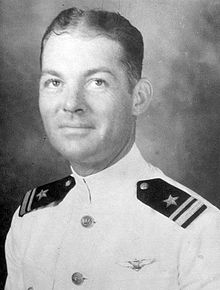
Lt. Hutchins, (LEFT) who remained at the controls until his men bailed out of the crippled plane, was awarded the Congressional Medal of Honor for his heroism.  The ultimately noble citation read, “Although his plane was badly damaged, Lieutenant Hutchins remained at the controls endeavoring to bring the damaged plane to a safe landing and to afford an opportunity for his crew to escape by parachutes. His cool, calculated conduct contributed principally to the saving of the lives of all who survived.  His conduct on this occasion was above and beyond the call of duty.”

Lt. Hutchins was further honored in 1942 when the destroyer, the U.S.S. Hutchins was named in his honor.  Lt. Cooper was also honored with a destroyer, the U.S.S. Cooper named in his honor. 

The seven-man crew of 11-P-3 never had a chance.  Radio man Rawls barely had time to send out a Mayday message. P-3 Pilot  Cooper did all that he could, never having the time to think about his beloved wife Frances and son Petie back at home.  The 105-foot wide plane burned and exploded into unrecognizable pieces. 

Four fortunate survivors of 11-P-4 had enough time to don their parachutes and jump to safety.  There were no survivors aboard 11-P-3. The bodies of the ill-fated crewmen of 11-P-3 were found except for Julian Rawls, John Neidsweicki and Martin Woodruff. 

Julian Rawls, (LEFT)  a native of Dublin and then a resident of Chula Vista, California, had been in the service for seventeen years, two years in the Army and fifteen years in the Navy.  Rawls, a radio operator, was eligible  for retirement in 1940.

Rawls, the husband of Evelyn Prince Watson, was born in Dublin in 1901 .  A son of O.H.D. Rawls and Julia Rawls, Julian grew up in a couple of homes on North Jefferson Street.  

All movements of the fleet ceased. Radio silence was lifted to initiate a search for survivors.  The search lights of 98 ships illuminated the crash zone in hopes of spotting survivors, any survivors.  At dawn, every ship, boat and plane were pressed into search and rescue operations.  No signs of survivors, victors, or Rawls’ PBY were ever found. The search was called off the following evening.    

The war games resumed.

Admiral Charles Blakey instituted an investigation of the cause of the collision and promised that the regrettable and costly accident would help the navy to prevent future accidents like this one.

The collision and resulting crashes of two PBYs were reported to be the greatest loss  of a heavier than air aircraft disaster in the history of the United States Navy.  Eleven men died that fateful night. 


Training accidents, a fact of life in the service, were common in World War II.  The collision was the third in six months in the area, leaving an even two dozen men dead.

The body of Dublin’s Julian Rawls, was reportedly never found. There is a cenotaph marker in North view Cemetery (Sect. D, Row 3) to mark the life of this man, perhaps our county’s first casualty of World War II.  

Yet, his grave marker does not indicate that he was a member of the U.S. Navy - only a worn tattered flag indicates that he was a patriot.  And,  Rawls’ name is not inscribed on the World War II monument on the courthouse lawn.  Now and forever, let us  remember Julian Rawls and his fellow men who gave their lives to protect our country, seventy five years ago this week.


Thursday, December 13, 2012

FRANCES WILLINGHAM - A WOMAN'S STORY OF SLAVERY


Frances could remember the days when she wasn't free. Some seven decades after she received her freedom, she sat down in her home on Bridge Street in Athens with Sadie B. Hornsby to relate her memories of the days when she lived in one room log cabin with a stick and mud chimney. Frances never forgot the day she was free to go were ever she wanted to, when she wanted to. This is her story, in her own words, a woman's story of slavery as she saw it. They are her words, written long ago in interpretation of her own simple dialect.

"I was born way off down in Twiggs County 'bout a mile from the town of Jeffersonville. My Pa and Ma was Otto and Sarah Rutherford," Frances recalled. There were nine children and parents living in a meager hut they called their home. "Our bedsteads was made out of rough planks and poles and some of 'em was nailed to de sides of de cabins," Frances remembered. The mattresses were stuffed with wheat straw while it was in season. "When dat was used up us got grass from de fields. Most any kind of hay was counted good 'nough to put in a slave's mattress," Mrs. Willingham said. "Dey let us mix some cotton wid de hay our pillows," she added.

In her four years of slavery, Frances was somewhat exempt from toiling in the fields. "Us chillun never done much but play 'round de house and yards wid de white chillun. I warn't but four years old when dey made us free," she reminisced.

Frances could still remember her grandmothers and aunts. "I remember once Grandma Suck, she wes my Ma's mammy, come to our house and stayed one or two days wid us. Daddy's Ma was named Puss." Both of her grandmothers were field hands, but her mother worked in the house carding and spinning threads. Her aunt Phoebe weaved the threads onto cloth and her Polly sewed the cloth into threads.

As a child, Frances never had any money. "Nobody never give slave chillun no money in dem times. I never had none 'til atter us had done been give our freedom." But, she did see the money that her master Elisha Jones had. " I used to see Old Marster countin' of it, but de slaves never did git none of dat money. "

Frances spoke somewhat highly of her master. " Our Old Marster was a pow'ful rich man, and he sho' b'lieved in givin' us plenty to eat. It warn't nothin' fine, but it was good plain eatin' what filled you up and kept you well. Dere was cornbread and meat, greens of all sorts, 'taters, roas'en-ears and more other kinds of veg'tables dan I could call up all day. Marster had one big old gyarden whar he kept most evything a-growin' 'cept cabbages and 'matoes. He said dem things warn't fittin' for nobody to eat."

Jones trusted Otto enough to let him go hunting on his won. One delicacy in Frances' family was possum. Her family had to cook everything in an open fireplace. I've seen Ma clean many a 'possum in hot ashes. Den she scalded him and tuk out his innards. She par-boiled and den baked him and when she fetched him to de table wide a heap of sweet 'taters 'round him on de dish, dat was sho' somepin good to eat," Mrs. Willingham fondly recalled.

As a child slave, her clothes were at least decent. In summer, the girl slaves wore homespun dresses, with full skirts sewed tight to fit their waists and fastened down on their backs with buttons made out of cows and rams horns. "Our white petticoat slips and pantalettes was made on bodices. In winter us wore balmorals what had three stripes 'round de bottom, and over dem us had on long sleeved ap'ons what was long as de balmorals. Slave gals' pantalettes warn't ruffled and tucked and trimmed up wid lace and 'broidery lak Miss Polly's chilluns' was," Frances concluded.

The adult slaves on the Jones' plantation wore rough brogan. Frances and the other children wore the hand me down shoes that the Jones children had outgrown. "Dey called 'em Jackson shoes, 'cause dey was made wid a extra wide piece of leather sewed on de outside so as when you knocked your ankles 'gainst one another, it wouldn't wear no holes in your shoes. Our Sunday shoes warn't no different from what us wore evvyday," Frances said.

Elisha and Mary Jones were wealthy by most standards. In the year before the Civil War began, Jones owned $20,000 worth of real estate and $36,500.00 of personal property including slightly more than fifty slaves.

"Marse Lish Jones and his wife--she was Miss Polly--was our Marster and Mist'ess. Dey sho' did love to be good to us. Dey had five chillun of deir own, two gals and three boys. Dey was: Mary, Anna Della, Steve, John, and Bob. 'Bout deir house! Oh, Missus, dat was somepin to see for sho'.

Frances remembered the Jones's plantation house near the Town of Marion, then the capital of Twiggs County. "It was a big old fine two-story frame house wid a porch 'cross de front and 'round both sides. Dere was five rooms on de fust floor and three upstairs. It sho' did look grand a-settin' back dar in dat big old oak grove," the old slave woman looked back.

Mrs. Willingham vividly recalled her old master, "Old Master had a overseer but he never had no carriage driver 'cause he loved to drive for himself so good." Willingham said that she never saw her master do anything except drive his carriage, walk a little and eat all that he wanted to because he was rich man and didn't have to do anything. She recalled that the plantation was very large and although she couldn't remember just how many slaves lived and worked there, she did remark, "Dat old plantation was plumb full of 'em."

Field work was hard. ""Our overseer got all de slaves up 'fore break of day and dey had to be done et deir breakfast and in de field when de sun rise up," Willingham remembered. The slaves would work all day past twilight before they came back to their quarters to eat supper and rest.

Whippings on the Jones place were somewhat rare, at least Frances never saw one. She did remember the dime when she climbed on top of the porch of the big house and flapped her arms and crowed like a rooster. " Dey told me to come on down, but I wouldn't mind nobody and kept on a-crowin' and a-flappin', so dey whupped me down," Willingham remarked.

Frances and the other slaves, although a few miles from the nearest battle at Griswoldville, saw the war coming to an end. Although she was barely four years old, she told her interviewers, "Mercy me! I'se seed plenty of dem yankees a-gwine and comin'. Dey come to our Marster's house and stole his good mules. Dey tuk what dey wanted of his meat, chickens, lard and syrup and den poured de rest of de syrup out on de ground.," Mrs. Willingham remembered.

Free from all the helpless despair of seemingly eternal bondage, Frances Willingham was no better off than she was before she was granted her freedom. She had little that she could truly call her own. Slaves had their freedom, but had little choice of where to go and how to scratch out a living. Many of the things the former slaves had provided for them were now gone or beyond the reach of their somewhat less than meager incomes would allow. Although legally free, many of the slaves remained on the plantations and continued to see their former masters as still their masters.


Education was almost nonexistent in those days for black children. "I ain't never been to school a day in my life, 'cause when I was little, black children weren't allowed to read and write," she remembered.

Going to church was different too. Before the war, slaves and their masters worshiped in the same church. After the war, congregations were ironically segregated. "Colored folks had their own church in a settlement called John the Baptist," Willingham remembered in recalling that she and the other children loved going to baptisms. "Day took dem converts to a hole in de crick what day had got ready for dat purpose. De preacher went fust, and den he called for de converts to come on in and have deir sins washed away," she said.

Funerals were primitive as well. Willingham explained that Elijah Jones had set apart a burying ground for his slaves adjoining his own family's cemetery. "Us didn't know nothin' 'bout no fun'rals. When one of de slaves died, dey was put in unpainted home-made coffins and tuk to de graveyard whar de grave had done been dug. Dey put 'em in dar and kivvered 'em up and dat was all dey done 'bout it," Willingham recalled.

Frances reminisced about a single wedding on her master's plantation. She never forgot the day when Miss Polly gave her one of little Miss Mary's dresses to wear to the wedding. "Only dey never had no real weddin'. Dey was jus' married in de yard by de colored preacher and dat was all dere was to it," she recollected.

Frances Willingham fondly recalled Christmas times in her youth. She remembered going to bed early because she and the other children were afraid that Santa Claus wouldn't come to see them. "Us carried our stockin's up to de big house to hang 'em up. Next mornin' us found 'em full of all sorts of good things, 'cept oranges. I never seed nary a orange 'til I was a big gal," she reminisced.

Food was plentiful in holiday times. "Miss Polly had fresh meat, cake, syrup puddin' and plenty of good sweet butter what she 'lowanced out to her slaves at Christmas. Old Marster, he made syrup by de barrel. Plenty of apples and nuts and groundpeas was raised right dar on de plantation. In de Christmas, de only work slaves done was jus' piddlin' 'round de house and yards, cuttin' wood, rakin' leaves, lookin' atter de stock, waitin' on de white folks and little chores lak dat," she remembered. Hard work resumed on the day after New Year's Day.

Medical care, although primitive at best, was available, if only on a limited basis. Of those days, Willingham recalled, "White folks was mighty good and kind when deir slaves got sick. Old Marster sont for Dr. 'Pree (DuPree) and when he couldn't git him, he got Dr. Brown. He made us swallow bitter tastin' powders what he had done mixed up in water. Miss Polly made us drink tea made out of Jerusalem oak weeds. She biled dem weeds and sweetened de tea wid syrup. Dat was good for stomach trouble, and us wore elder roots strung 'round our necks to keep off ailments," Mrs. Frances remarked.

The women of Frances Willingham's day had little rest, even after leaving the fields. She recalled that when the slaves came in from the field, the women cleaned the houses after they eat and washed clothes early in the morning so that they would be dry for the next day. She remembered that the grown men would eat, sit around and talk to other men and then go to bed.

Saturday nights were a time to frolic. Quitting time came around three or four o'clock in the afternoon. "Sadday nights de young folks got together to have deir fun. Dey danced, frolicked, drunk likker, and de lak of dat. Old Marster warn't too hard on 'em no time, but he jus' let 'em have dat night to frolic. On Sunday he give dem what wanted 'em passes to go to church and visit 'round," she reminisced.

Jones allowed his workers little rest from the time crops were planted until they were harvested. "My master did allow us slaves to have cornshuckin's, cornshellin's, cotton pickin's, and quiltin's," said Mrs. Willingham. Jones's groves of pecan, chestnut, walnuts and other trees were lucrative . When all the nuts were gathered, Jones sold them to the rich people in the cities. Afterwards, he gave his slaves a big feast with plenty to drink. After a long celebration, Jones allowed the slaves a few days to recover before resuming their grueling duties.

In her final years, Frances Willingham reflected on her freedom, "Me, I's so' glad Mr. Lincoln sot us free." She believed that if she was still a slave, that she work just the same, sick or not. "Now I don't have to ax nobody what I kin do. Dat's why I's glad I's free," Willingham concluded.

After leaving the Jones plantation, Frances moved to Putnam County, Georgia, where she married Green Willingham, of neighboring Jasper County. "I didn't have no weddin'. Ma jus' cooked a chicken for us, and I was married in a white dress. De waist had ruffles 'round de neck and sleeves," she said as she looked back to her wedding day.

Frances Willingham lived a long life. She worked hard to provide for her seven boys and ten girls. Then as she got older she did all she could to look after her 19 grandchildren and 21 great grandchildren.

In this month of March when we celebrate Women's History Month, let us look back and reflect on all the Frances Willinghams of the world, who toiled and worked with little rest to provide for their families as best as they could.

HERSCHEL V. JOHNSON


A Higher Calling

In a place and time when seeking and holding high public office was seen more as a duty than a way to line one's pockets or further one's own personal goals, Herschel Vespian Johnson, of Jefferson County, Georgia, did it all.  In his nearly four-decade-long political career, Johnson served as a United States Senator, Governor of Georgia, Confederate States Senator, and Superior Court Judge.  One of the few people in the history of Georgia to have a county named for them while they were alive, Herschel V. Johnson is the only person in the history of our state to sit on bench of the Superior Court of the very county which was named for the judge.

Herschel Johnson was born on September 18, 1812 in Burke County, Georgia. Johnson graduated from the University of Georgia in 1834 with classmates, Howell Cobb and Henry Benning.   While a practicing attorney, Johnson appeared in the Laurens County Superior Court in 1843 on behalf of the Central Bank of Georgia.  That same year, Johnson successfully defended Jacob T. Linder in a suit by Dr. Nathan Tucker to recover damages for taking a slave woman, Celia.  The case continued in the courts for several years.  Johnson also represented John L. Martin in minor contract cases.

After an unsuccessful campaign for Congress later that year, Johnson moved from  Louisville, Georgia, which had formerly been the state's capital, some twenty-five miles to the west to the capital city of Milledgeville to better position himself for high political office.  He jumped right in and served as a Presidential Elector in 1844, committed to James K. Polk, a close relative of his wife, Mary Ann Polk. 

Johnson positioned himself as a strong opponent to Mexican War.  When he called Alexander Hamilton Stephens a liar, the little political giant challenged Johnson to a dual.  Although the men would later become friends and political allies, the feud between them lasted nearly an entire decade.  

Johnson lost his first campaign for governor in 1847, but in the process, earned the favor of Gov. George W. Towns, who appointed him to fill the remaining term of United States Senator, Walter T. Colquitt, who had resigned from office in early 1848.  It was in those days when Georgia was politically divided, when Towns, the victorious Democratic candidate, won the election by a mere 1278 votes over Duncan Clinch, the Whig candidate, who was more highly favored by the voters of East-Central Georgia, especially in Laurens where the Democratic candidate received less than five percent of the vote.  Senator Johnson served the remaining term of thirteen months.  While in Washington, the Senator served with political icons, Jefferson Davis of Mississippi, Stephen Douglas of Illinois, Sam Houston of Texas and Daniel Webster of Massachusetts.  

On November 13, 1849, Herschel Johnson became Judge Johnson, presiding on the bench of the Ocmulgee Superior Court Circuit, centered in Baldwin County.  He served in that position in 1853 when he launched another political campaign.

As the rift over the issue of slavery, state rights and secession paralyzed the country in the early 1850s, so did it divide the state of Georgia.  In the gubernatorial election of 1853, Johnson was chosen by the State Rights Party to run against Charles J. Jenkins, of the Constitutional Union Party, which was in favor of remaining in the Union, although it was not opposed to slavery itself.

Johnson won the election by 510 votes and a scant one half percent of the total votes cast.  In Laurens, the strongest bastion of the  Constitutional Union Party,  in the state,  Johnson received only 51 of 569 votes cast.  Most of the other counties in East Central Georgia also supported the Union party.  Two years later, the vote tabulation  was substantially the same with  Johnson winning the election despite the overwhelming support from Laurens and East Central Georgia counties  for American party candidate Garnett Andrews. 

As a salute to their party leader, the Democrats honored Johnson by naming Georgia's newest  County in his honor on December 11, 1858.  

As war became more eminent in the latter years of the decade, Johnson modified his position and became an opponent of secession.  At the 1860 Democratic Convention in Baltimore, Johnson accepted the invitation of his former senate colleague, Stephen Douglas as his vice-president.  In that divisive election, the fractured Democratic party could not defeat the solid Republican party led by Abraham Lincoln.  In Laurens County, Johnson's place on the ticket drew little support from local voters.

In the 1861 Secession Convention in Milledgeville, Johnson vehemently opposed secession along with his former enemy Alexander Hamilton Stephens and former court opponent, Dr. Nathan Tucker of Laurens County.  Like many of those Georgia leaders opposed to secession, Johnson relented and vowed to support his state when Georgia officially voted to leave the Union.  

Johnson served as a Senator from Georgia in  the Second Confederate Congress,  from 1862  to  1865. Senator Johnson, still not in favor of prosecuting the war, opposed Governor Brown's plan of conscription and the suspension of the sacred right of habeas corpus. 

When the war was over, Johnson along his friend and fellow Unionist, Alexander Hamilton Stephens were elected by the Reconstruction government to represent Georgia in the United State Senate. The  Republican dominated senate declined to seat Johnson and Stephens, the Vice President of the Confederate States of America, because of their roles in the Confederate government during the war.

No longer a factor in Georgia politics, Johnson, then sixty years old, returned to the bench of the Superior Court as Judge of the Middle District of Georgia.   His most celebrated case came in the summer of 1875, when he presided over the trials of several Negro defendants charged with insurrection.  The former slaves allegedly plan to reek havoc between Sandersville, Wrightsville, Irwinton and Dublin by pillaging the farms of white landowners.  Interestingly, the defendants were acquitted or the charges were dismissed in a still racially volatile atmosphere.  

Two of Johnson's children would call Dublin home.  In 1878 in Jefferson County, his daughter Gertrude married Col. John M. Stubbs, attorney and businessman with ardent interest in transportation, journalism and agriculture. His son, Dr. Herschel V. Johnson, Jr., who bore a striking resemblance to his father,  practiced medicine in Dublin in the late 1880s until his death there in 1891.

Johnson remained on the bench until his death on August 18, 1880 in his home in Jefferson County.  He is buried in the Old Cemetery in Louisville beside his wife.

On this 200th anniversary of his birth, Senator, Governor and Judge Herschel Johnson was a man who sought out a higher calling, a man who strived to serve his state with honor and a man who helped shaped our state and our nation.  Had his change of beliefs been successful and his desire to keep Georgia in the Union had held firm, the face of our country would have changed forever.

LESTER GRAHAM


First Marine


You will not find the name of Lester F. Graham on the monument to those Laurens County men who lost their lives in World War II.   Those names are only the men who lived in Laurens County at the beginning of the war, or at least our country’s entrance into the war.   If you were making a list of those who served and fought in World War II, the name of Lester Graham would be right up there at the top.   After his graduation from Dublin High School, Lester joined the United States Marine Corps and entered basic training at Parris Island, South Carolina in the fall of 1934.  

When one thinks of Marines of that day, they think of the Marines who fought in the South Pacific in World War II.   In time, Lester Graham would become one of those Marines.  When Lester got to the scene of the fighting in the South Pacific in 1942 with the First Marine Division, he had already crossed the South Pacific twice on his way to two tours of duty in China.

Lester F. Graham was born on July 14, 1914 to John J. Graham and Pearl Carr Graham, of Empire, Dodge County, Georgia.  

You see, Lester Graham was what they once called a “China Marine.”  With the aid of Russia, the United States and yes, even Adolph Hitler’s Germany, the Republic of China engaged in a war with the Empire of Japan, after the Marco Polo Bridge Incident.  To help protect American economic interests and citizens in the area, President Franklin D. Roosevelt ordered the 4th Marines to the vicinity of Shanghai.  

It was in the summer of 1937 when an intense struggle for control of Shanghai erupted.  Just north of Soochow Creek, the antagonistic armies of China and Japan collided in brutal combat - all combat is brutal.  The 300,000 man Japanese Army launched an all out offensive in October, seventy five years ago this week.  Further resistance  was futile. With only 6500 British and French forces and  a mere thousand Fourth Marines in support, the  Chinese retreated to fight another day. 


After a lull in the fighting in downtown Shanghai, Graham took a little time to write his mother, the former Miss Pearl Carr, at her home at 303 Telfair Street, now part of Duncan Tire Company.

“Dear Mom, I hope you aren’t too frightened by me being here, because there is hardly any danger.  All I have to do is to keep near sandbag emplacements and duck when I hear shells and bombs whistling,” Lester wrote.  

Graham told his mother that some  times the Japanese fired into the American  lines, but never hit anyone.  The Dublin Marine reported that only a few foreign soldiers had been killed during the fighting, but he did relate an incident when an enemy aerial shell struck within seventy yards of his fortified position.  When the excitement subsided, Lester and his buddies ventured out to pick up a few souvenirs from a crashed Japanese airplane.  Although he planned to bring some large pieces home on his next visit, Lester sent his mother a small piece of the bounty of war.

“The officers really gave us a workout when we first arrived here.  We had to build sandbag emplacements, put up miles of barbed wire and cut portholes through brick and stone walls,” Graham wrote.  

Graham, a private in C Co., 1st Battalion, 4th Marines, wanted his mother to know that he often talked about her mother, “Big Mama,” to his fellow Marines, and what “darned good biscuits” and ham she can cook.  

He ended his letter with the usual sentiments and asked all not to worry about him.

Graham returned to China in May 1938 aboard the U.S.S. Sacramento for a 15-month hitch.

After serving relatively light duty in his first years in the Marine Corps at the Naval Prison in Portsmouth, New Hampshire, Lester received orders just before Christmas 1939 to report for duty at the World’s Fair in New York.  Being in the Big Apple in those happy times leading up to the war was a thrill of a lifetime. At every turn, there was fun and happiness. 

After the war with Japan began in December 1941, Corporal Graham served in Marine installations primarily on the East Coast of the United States and assignments in Puerto Rico and Cuba.  

In April 1942, Corporal Graham was assigned to C Company, 1st Battalion, 1st Marines, 1st Marine Division.  As a part of the Marine Corps’ first major offensive against Japan, the 1st Division attacked on several fronts during the Guadalcanal Campaign.  Roughly 7,000 good men were lost in contrast to the deaths of some 30,000 plus resolute Japanese defenders.

During the middle of the six-month unmerciful campaign, Sgt. Graham was promoted to Platoon Sergeant Graham.  In July 1943, Graham added a fourth bottom stripe on his sleeve when he was elevated to the rank of Master Gunnery Sergeant.  

In December 1943,  just three short years after Lester was living the easy life on the busy streets of New York City.  Graham found himself entangled in a savage struggle when the First Marine Division staged its second amphibious landing in a series of fights called the Battle of Cape Glouchester.

Somewhere in the fighting on January 23, 1944, First Sergeant Lester F. Graham was killed in action.  His body was brought back home and buried beside his father in the Rogers Cemetery, near Empire, in Dodge County, Georgia.

 So now you know part of the story of Lester F. Graham, First Marines, a Dublin man, a China Marine,  who fought to protect Americans in the volatile streets of Shanghai, China, seventy-five years ago and became the first Laurens Countian to serve in World War II. 


ROY MALONE - A FIGHTER FOR FREEDOMS


A FIGHTER FOR FREEDOMS


For all of the last seven decades, Roy Malone, of Dexter, Georgia has fought for freedoms.  In the South Pacific in World War II, he flew a fighter plane fighting for our country's freedoms.   Since his return to Laurens County, Malone has fought to build a better home for his family, better methods of farming, wiser soil conservation and  tree farming policies and ways to improve  the beauty of the Earth which he cherishes so, so much.


Roy Malone's world and his life were turned upside down on March 14, 1944.  Second Lieutenant Roy Malone qualified to become a member of the Caterpillar Club.  To achieve this somewhat dubious honor, Malone had to endure bailing out of his P-40 fighter plane under the most of perilous circumstances.  


It was at Aloe Field on the outskirts of Victoria, Texas where Roy Malone, a Laurens County  farm boy, received his commission as a Second Lieutenant in the U.S. Army Air Force.   As he and his buddies were preparing to ship out to fighter school, the pilots decided to get in a little practice for the rigorous training which lay ahead.


"Nine of us took P-40 fighter planes up to do some simulated dog fighting," Malone recalled.  Trying to position himself on the tail of another plane and at the same time trying not to allow someone else to line up on him for a shoot down, Lt. Malone got into position behind one of the planes. He was locked in on his target, moving in for the theoretical kill.  That's when Lt. Frank Mesojedec slipped in and got on his tail. "He had locked in on me but was coming in too fast.  As he shot past me he came too close, clipping my right wing with his left wing," Malone remembered. "That kind of thing happens in training, we weren't the only ones," the lucky pilot added.


Both planes fell into lethal spiraling spins.  And, both pilots managed to bail out, though they were flying at low altitudes.  "My chute opened about 200 feet off the ground and it had just enough time to open and sway back  and forth once before I landed in an oak tree about 20 feet up," Malone recollected.  Lt. Mesojedec was not as fortunate.  His chute failed to open in time.


Battered, broken, and bruised, Malone stayed in the hospital for a week. With just one day to spare, Roy, missing one tooth and still sore from the impact,  was discharged and joined his buddies as they shipped out to fighter school.  It was one of the two most memorable moments Malone would experience in his long military career.


It was a day that changed his life forever.  Lt. Malone came within an eyelash of being a casualty of World War II and a hero whom we honor on this Memorial Day.


Roy tried not to worry about the dangers of being a fighter pilot.  "When we came back from a mission, the flight surgeon gave us two ounces of liquor to calm our nerves," he recollected.  Malone, who didn't drink, began to accumulate his liquor in a bottle with his name marked on it.  To relieve the stress, Malone and his buddies wrestled, played games, and exercised whenever they could.


One day an infantryman walked by Malone's tent and asked the pilot if he wanted to buy a Japanese sword.  When Roy responded that he didn't have any cash, the soldier wondered if Malone would be interested in swapping some of his aerial combat liquor for his sword.  Malone agreed. The deal was done.  Today, that sword is among a large collection of memorabilia which has been lovingly curated by Malone's wife, Sarah, and his daughter, Gail Poole.    


Malone has seen dying and death in war time, from high above to down low skimming the deck over places like Nagasaki, Japan, where he photographed the total inhalation of the second atomic bomb.  He takes no glorious pride in the destruction which his P-51 fighter reeked upon the Japanese people and their infrastructure, but he makes no apologies for it was his mission, a mission he was thoroughly trained to do.


August 6, 1945 was one of those days Roy Malone which will never forget, although at the time,  he didn't realize that America had dropped an atomic bomb on the Japanese city of Hiroshima.


"Before we were sent up there on a flight, we were told to stay away from a particular point by 75 to 100 miles," Malone recalled.  A few hours after the night time explosion, Malone was flying in the Hiroshima sector and observed the mushroom cloud dissipating into the stratosphere as a new era in the history of the world dawned.


Two days after the second atomic bomb was dropped on Nagasaki, Malone was ordered to fly over the city at low levels to take pictures of the results of the war ending attack.  It would be the second most memorable day of Roy Malone's career as an aviator.


"I took a wing man with me," said Malone, who was a wing leader at the time.  "Although there was no cease fire in effect at the time, we were ordered not to fire at anyone unless fired upon first," he added.


"About 15 to 20 miles out, I got down on the deck," Malone recalled.   He  flew 200 feet above the obliterated countryside, snapping photographs with his automatic K-34 camera as his plane screamed just above what used to be tree tops and buildings.


"There wasn't anything there but dust.  Every now and then you would see the hull of a building," said Malone, who reported that he never saw any sign of human life at all.


On the left was a mountain and on the right was a place where ships were moored. Malone flew his plane toward the open sea just in case he was fired upon.  Pilots preferred head toward the sanctuary of the ocean where they could be rescued by friendly naval forces if they were shot down.


"When I snapped a series of pictures, I  dropped down near the water and went around the back side of that mountain, which had a sheer drop into the sea.  Then I saw a cotton pickin' heavy cruiser.  I didn't know it was there because it was well camouflaged," Malone remembered.


"I saw Japanese running for their guns and said to my self, 'Dang, I better do something,'"  Malone chuckled.  Deciding that discretion is really the better part of valor, Malone wheeled his P-51, which he dubbed the "Georgia Rebel,"  around and raced to the city side of the mountain, which had been nearly sheered away by the atomic bomb blast.


At first, Malone worried about the dangers of radiation, but was assured that he was never in any real danger. He never thought for a moment that his commanders would put him in a perilous position like that.


The two bombs brought about a quick end to the war, which was projected to last up to  several more years against determined defenders of the island country of Japan.    In the months leading up to the detonations, Malone and his squadron accompanied B-25 and B-29 bombers on raids on important Japanese targets.


"There was no contest as they were saving their fighters for kamikaze suicide planes," Malone remembered.   The former pilot commented that during some of those raids, 80 to 90 thousand people were killed from bomb blasts and the resulting rapidly spreading infernos every single night.  And, he has his own original  pictures to prove it.


"It was terrible. Golly!  When I think that could happen over here in some future war, it's frightening," lamented Malone.


At the end of the war, Roy had to make a decision.  While he was in the service, Roy had been making payments on a piece of land.  Having a desire to farm, unlike his four brothers, Roy chose to come back to Dexter to resume life as a farmer and foregoing a three-year hitch in the Army Air Force, or so he thought.  


After he retired from active duty, Roy Malone joined the reserves.  He fondly remembered going over to Dobbins Air Force Base from Athens, where he was attending the University of Georgia.   Roy always enjoyed flying an old P-51 back home to Dexter just to get in his minimum hours of flying time.


During his time as a pilot in the Pacific, Roy and his fellow pilots lived mostly in tents. Only once or twice did they ever get to sleep in a real building.  "We never got time off.  We lived in tents and had to be ready any minute to go on another mission," Malone recalled.  "At Ie Shima, we dug fox holes next to our tents so that if there was a bomb strike at night, we could dive in them," he said.


"Over there you could save money. We had no expenses and nowhere to spend our paychecks," Roy recalled. To compensate for the lack of decent quarters and less than  decent food, Roy was given separation pay of  slightly more than $8,000.00.  The check came as a big surprise to Roy, who knew exactly what he wanted to do with the money, pay some of his debts off and buy a little more land.


Turns out, he did a lot of both.  Roy came home to Dexter and began farming, married Sarah Weaver and started a family, which included his children, James, Pat, Pam Mullis and Gail Poole.  And, he remained in the Air Force, serving for a total of roughly thirty years.  He retired as Lt. Colonel, serving as an Air Force Reserve instructor and as an advisor to cadets of the United States Air Force Academy.  His awards and decorations are too numerous to mention here.


"I think right now we are in good  shape against China, Russia and emerging nations which could show hostility," commented Malone on the present state of the  military.  


"I would  hope that our academies will be seeking out, finding and getting the very best brains in the country, and that our staff people and our Congress will fund the kind of effort that will keep us ahead of our adversaries," wishes Malone for the future of American military readiness.


"We sit here with the best country in the world, with our abundant resources and with our vibrant people.  And, our way of life is coveted by the whole world.  Some of them covet us because they would like to come here and  live with us.  Some of them covet us because they hate our guts and they would like to take what is ours," proclaimed Malone.


"If we don't stay strong and vigilant, we are going to lose it down the road," Malone warns.  He also hopes that there will be the will on the part of the people to perform when necessary to protect our freedoms.


"We had patriots who were willing to defend and fight for our freedoms, and to defend those freedoms which were gained and preserve them," the former fighter pilot maintains.  "We would like to think that we have the talent, the resources and the will to defend those freedoms.  If we don't, we will be in a tough situation," he claims.


Today, at the age of 91, Roy Malone, a veteran of three war time eras,  enjoys the freedoms that he and millions of others fought for.  On each Memorial Day, he pauses to think about the hundreds of thousands of American military personnel who have given the the last true measure of devotion by sacrificing  their lives for their country.


And on most days, you will find Roy somewhere on his Goose Hollow farm in the Dexter suburb of Springhaven, where he has lived the ultimate American dream for most of the last seven decades.


As he rides through the farm checking on his crops and trees, Roy Malone's thoughts sometime go back to his most everlasting memory of the war on  that March day in 1944, when his life was spared and his buddy Frank Mesojedec didn't make it.


Roy Malone was one of the lucky ones.  He made it home and has enjoyed a most wonderful life.  And, we are all lucky that he did.


Friday, September 14, 2012

JEFF DAVIS


THE KEEPER OF THE DREAM


Dreams do come true. This Jeff Davis knows. When he was five years old, Jeff climbed the steps of a castle. His father helped him through the "rolling doors." His eyes beheld a dream. And, one day, he told himself and his daddy, that the old Post Office on Madison Street was going to be his very own building.

And, today, on the 100th anniversary of the building's opening as the Dublin Post Office, Jeff Davis's dream has come true. To celebrate the occasion, he has invited his friends to commemorate the beginning of the second century of a true Dublin landmark.

"I remember the steps. And, when I got to the top, it was the biggest building that I had ever seen. I didn't know what to do at the door. My dad came and got me. And, I came in the lobby and thought it was a castle. Even at five, the building floored me," Jeff recalled.

It was on August 2, 1912, when Dublin's grand new post office opened for the first time. Situated on East Madison Street in the heart of the agra-industrial district of the Emerald City, the post office was the one of the city's focal points for businessmen and residents.

Too small even from the beginning to accommodate a post office in a burgeoning city, the capacity of the building was furthered reduced by the need for a Federal court room, a move necessary to accommodate the rapidly growing number of moonshine cases in the district. Accordingly, the Federal government constructed a courtroom above the main workroom of the post office in the late 1920s. Within five years, plans were underway to build a new Federal building on the courthouse square, leaving the Madison Street Post Office to be occupied by sundry offices of county and state government in 1937.

In the early 1970s, Laurens County sold the building to Joe Rutland, who operated a pawn and antique store in the building for three decades. Over the next few years, the building housed a restaurant and a bar, before becoming the home of Will and Jennifer Carter.

"You have to give all the credit to Will Carter and his wife, Jennifer, because they lived here and this building was their home. They loved it and they were good caretakers of the building," Davis proclaimed as he praised the Carters, who knew all the original details and never harmed anything which was original to the building.

After watching the activities in the building for several years and appreciating the rebirth of the downtown area, Davis contacted Carter about purchasing the empty structure. The Carters agreed to sell what was once their dream as well. The Carters even attended Rutland's estate sale, where they spotted and retrieved the building's original blue prints, which now hang in the lobby of the post office building, professionally framed underneath special light resistant glass.

Davis, the current Dublin Rotary Club President, was looking for a new location for his growing data storage business, Alterra Networks, a full service information technology solutions provider.


"From a business and a technology standpoint, Dublin is well located for a data center," said Davis, whose new quarters has a 4500 square foot basement. The Dublin native approached the project with the goal to make the main floor and the second floor like it was on Day One in 1912, adapting them to house his offices and getting a data center in the basement for free. To add icing on the cake, the building is located along the city's fiber optic network line.

"When I bought the building, it took me about four or five times in there to realize that about 85 percent of the building was still here," remarked Davis, who personally flyspecked every nook and cranny of the sturdy structure finding hidden clues to its past. Sometimes the clues came to him in the form of stories of bygone days and visitors to the building. He discovered secret windows in the top of the work room, where the postmaster and inspectors could spy on employees, looking for sticking fingers while they were sorting mail and taking money orders.

There are large fixtures intact as well as small ones. In Davis's personal, second-story corner office, there is an original light switch. There's even a triangular sink in the corner right next to a century old towel holder. From his vantage point, Davis can look out the window gazing toward what was once the heart and soul of the industrial and agricultural center of Laurens County.

He can even tell you where the post office bought their sweeping compound, toilet paper, coal and light bulbs from. He knows this because he contacted the National Archives and received more than 1500 pages of records, which document in exact details all of the activities which went on during the construction and operation of the building during its early years.

With most of the original plans in hand, Davis set out on a passionate mission to restore, replicate, or replace as much of the original building and its fixtures as he could. He doesn't see it as one shot deal, but a long term process.

"Everything that is not here can be put back with one hundred percent certainty," Jeff maintains.

One of the first things Davis noticed was that the original lobby clock was missing. After examining his mounds of documentation, he determined that it was a Seth Thomas Model 21, 14- inch gallery clock, the only one they made that year. Davis went on eBay, quickly found one, and bought it at a price less than a modern day clock would cost. Although the original clock had to been wound by hand, Davis adapted the replacement clock to run off long lasting batteries.


Obviously missing were the original post office boxes, which were removed when the county took over the building in the 1930s. Davis had seen an original one in the Dublin- Laurens County Museum and set out to research the kinds of boxes which were originally installed. It was back to eBay, where he purchased similar boxes by the hundreds, which he then had polished and reinstalled exactly where they were a century ago.

There is one thing that Jeff Davis doesn't plan to immediately restore. There is a row of windows for different types of services which the postal service provided. In front of the main stamp window, there is a bare spot, where the feet of hundreds of thousands of customers completely eroded away the marble floor.

One day he was outside and noticed several dozen people posing for a picture on the front steps. The group assembled there to remember the day many decades ago when the patriarch and matriarch of the family met for the first time. Their descendants gather there periodically to remember the seminal event which led to their becoming a family.

"I don't know anybody who hasn't walked through that revolving door whose breath is not taken away," said Davis about the building's most striking feature.

In 1937, when the county moved in, the building was only a quarter century old and lots of changes had already been made.


"The biggest sin which was committed against the building was the by the Federal government, putting in that temporary courtroom, cutting that room in half. Just to undo that and get the light flowing again and getting the windows uncovered, that is the thing that I am most proud of," said Davis.

"The public has not seen the building like this for 80 years. No one alive, other than the workers, has seen the building in 80 years without the temporary courtroom," said Davis, whose workers had to strip away three coats of paint on each side of the lobby windows to remove the impudent impediments to the building's original grandeur. .

"This building is all about light, natural light. There are very few light fixtures in the building," Davis commented as he pointed to the fact that he and his employees work until early in the evening without turning on a single light.


"I want it to be downtown's formal living room. I want it to be a gathering place," says Davis, who believes that the building is just warming up.

"This building was built when this country was very rich and architecture was an honored discipline. There was a real good quote from the Secretary of the Treasury at the time, 'We can use these post offices in small towns to inspire the citizens. We can put the most architecturally beautiful building in a community and hope that we can inspire the other citizens to build to that level,'" says Davis, who believes that the building was built to make a statement and still can.

"There will never be another one like this building. Even though I am the caretaker of it now, this building belongs to everybody. When you put yourself in that context, you can't really say that you own this building," Davis believes.

"My inspiration comes from thinking about the day when the folks we read about in the history books who built houses on Bellevue came through those doors. They did business down here. And, then there were people who were just regular folks and did business here at the post office," Jeff remarked.

Davis can even imagine the building being here after another 100 years or even a thousand years from now. He foresees, "There will be a day when school children will come here and be informed that once we sent paper to each other and we had to build these buildings to receive and route these paper communications."


"It's a special building. It holds a special place in people's hearts," Jeff Davis believes.

In particular, the building always reminds Jeff Davis of that unforgettable autumn day when his late father stopped in to pick up some shot gun shells to go on a dove hunt out a James Rawls' farm. It was that day, the very first day, when Jeff began to imagine his dream.